
I. Why I Started Taking Server Selection Seriously: My Projects Outgrew Basic VPS Options
When I first started using VPS, I didn’t really have a clear concept of the technical nuances. As long as I could run code, deploy a Telegram bot, and host a small website, I felt it was sufficient.
However, as my projects multiplied, I began to notice a significant disparity in performance across different VPS providers. Some machines ran fine under low loads, but the moment concurrency increased or background tasks kicked in, they would lag, latency would spike, and service stability would suffer.
The turning point—where I realized the severity of the issue—came with an API service and Telegram bot project I was developing. These required 24/7 uptime, yet on standard VPS instances, I frequently encountered inexplicable latency fluctuations, sometimes even requiring manual service restarts.
It was during this period that I began searching for a more stable solution and eventually discovered VDSina’s AMD EPYC cloud servers.
II. Why I Became Interested in AMD EPYC Cloud Servers
Initially, I paid little attention to CPU architecture; I cared only about price and whether the server could “get the job done.”
It wasn’t until I started running long-term services that I realized the CPU is the core factor determining performance quality.
For instance, when running API services or data processing tasks, standard VPS instances often suffer from sluggish response times as soon as concurrency rises. Often, the issue isn’t the code itself, but rather CPU throttling or resource overselling, leading to unstable performance.
I later learned that many low-cost VPS providers rely on heavily shared CPU resources, whereas AMD EPYC utilizes a server-grade, multi-core architecture that is far better suited for high concurrency and sustained workloads.
This is precisely why I decided to give VDSina’s AMD EPYC cloud servers a try.
III. My First Experience with VDSina AMD EPYC Cloud Servers
I was actually a bit skeptical when I first tried VDSina’s AMD EPYC cloud server. Having previously encountered VPS providers that boasted impressive specs but delivered mediocre real-world performance, I had become wary of such marketing claims.
However, once I actually started running workloads on it, the experience was noticeably different from the machines I had used before. The most immediate impression is that the system remains stable even under heavy load; there are no sudden stutters or spikes in latency. On standard VPS setups, running just a few concurrent tasks—such as combining API requests with background script execution—often caused the system to slow down, sometimes even making SSH operations sluggish.
However, in the AMD EPYC environment, this kind of “jitter under load” is significantly reduced. Overall operation is smooth, and there are no noticeable performance fluctuations, even when handling multiple tasks simultaneously.
Another aspect that really stood out to me is the stability of long-running tasks. I have scheduled data processing scripts that frequently suffered from latency accumulation or missed execution times on my old VPS—sometimes even requiring manual service restarts. Since migrating to VDSina, these issues have essentially vanished; tasks execute reliably as expected without requiring frequent intervention on my part.
IV. Actual Projects I Run on VDSina
After confirming the stability, I gradually migrated multiple projects to this AMD EPYC cloud server environment.
The first to be migrated was a Telegram bot, as it requires 24/7 uptime and high stability. On the old VPS, it occasionally experienced latency or brief periods of unavailability, but its operation has been noticeably more stable since the migration.
Later, I deployed several API services, such as weather interfaces, data processing endpoints, and automated task systems. These services are characterized by variable request volumes—ranging from light loads to sudden bursts of high concurrency. If server performance is unstable, slow response times easily occur.
In VDSina’s EPYC environment, these fluctuations are significantly reduced; the overall experience feels like “consistently stable performance” rather than just “occasionally running very fast.”
Eventually, I even consolidated some small-scale web projects onto the same server for API testing and project demonstrations.
V. The Core Experience of AMD EPYC Cloud Servers
After using the service for an extended period, I have gained a clearer understanding of AMD EPYC cloud servers.
Their greatest advantage isn’t necessarily that any single performance metric is exceptionally high, but rather that the overall output is incredibly stable.
The CPU doesn’t suffer from significant speed drops during concurrent multitasking, NVMe storage offers rapid response times, and network performance remains smooth over long periods of operation. The experience this combination delivers is simple: you don’t have to worry about “when it might slow down”; instead, you can take its consistent stability for granted.
For someone like me who frequently runs APIs, bots, and background tasks, this reliability matters more than raw peak performance.
VI. Summary of the VDSina AMD EPYC Cloud Server Experience
After using the service extensively, I took a closer look at the structure of VDSina’s AMD EPYC cloud server plans.
It features a classic “highly elastic architecture.” The base configuration starts with an 8-core, high-frequency AMD EPYC CPU, but you can freely scale between 1 and 128 cores, with billing based on the core count. Memory is flexibly scalable from 1GB to 512GB, and storage utilizes NVMe SSDs, starting at 100GB with options for higher capacities.
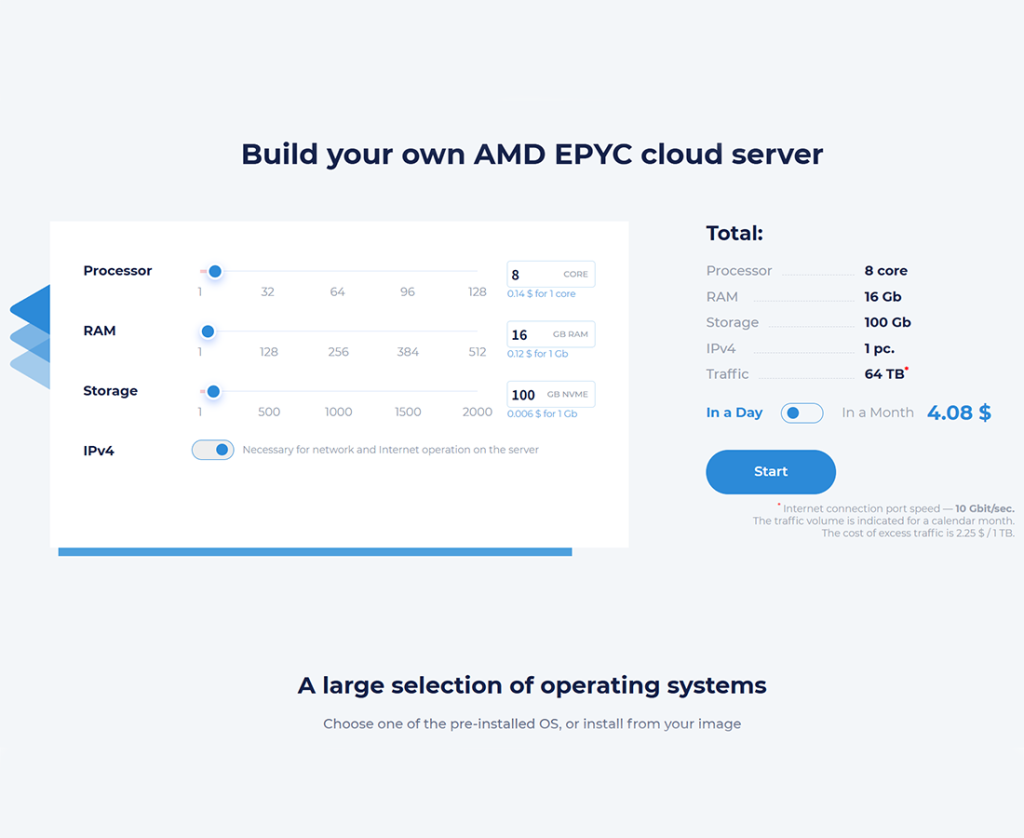
Networking is a key factor for me; the service provides a dedicated IPv4 address and a standard 10Gbps high-speed port. It also includes 64TB of free monthly data transfer—more than enough for API services, data processing, or high-traffic projects.
The billing model supports switching between daily and monthly rates, keeping overall costs low. A common configuration I tested cost around $4 per month, and billing stops when the server is powered down—a feature that is incredibly convenient for short-term testing projects.
In terms of user experience, this system feels more like “on-demand scalable development infrastructure” than a traditional, fixed VPS plan.
VII. The Shift from Standard VPS to EPYC Cloud Servers
Looking back, the transition happened quite naturally.
At first, I focused only on price; later, I prioritized specifications; then, I began to value stability; and finally, I truly grasped the importance of CPU architecture and sustained performance under load.
The biggest change the AMD EPYC cloud server brought me wasn’t just “being faster,” but “being consistently fast.”
VIII. Stability Matters More Than Specs
If I had to summarize my logic for choosing a VPS now, I’d put it simply: a server isn’t just for testing whether something can run—it’s for ensuring the project keeps running reliably.
In my actual usage, VDSina’s AMD EPYC cloud server has saved me from a lot of unnecessary hassle, allowing me to focus on development rather than infrastructure issues.










+ There are no comments
Add yours